


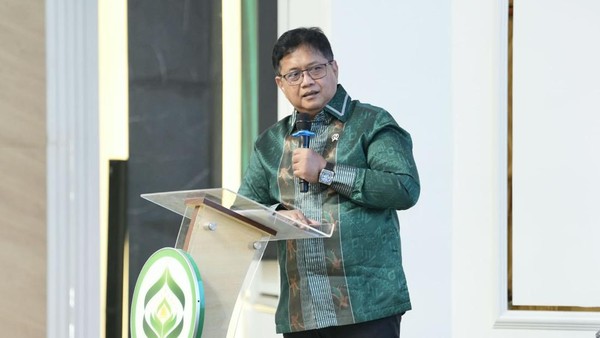
JAKARTA, Oct 12 — The National Mandate Party (PAN), a member of Indonesia's ruling coalition, said on Monday it has yet to take a position on calls to impeach Vice President Gibran Rakabuming Raka, as the party reviews a Constitutional Court ruling on a challenge over his educational qualifications.
PAN Deputy Chairman Viva Yoga said the party would study the court's decision carefully before deciding its next step, stressing that its deliberations would be guided by national interests rather than political calculation.
"PAN will review the Constitutional Court's ruling thoroughly," Viva told reporters on Monday (Oct. 12, 2026).
"The goal is to serve the interests of the nation and the state, not the interests of power," he said.
The statement leaves PAN neither backing nor rejecting the impeachment push, which has gained momentum since the Constitutional Court on Oct. 6 read out its ruling in case No. 01/PHPU.PRES-XXIV/2026. The court declared the petition inadmissible on grounds of legal standing, but noted in its legal considerations that it had found no convincing evidence during the hearings that Gibran held a foreign diploma, certificate or academic credential that could be recognized as equivalent to the minimum requirement of a senior high school education.
The ruling has fueled a campaign led by the petitioners who challenged Gibran's eligibility as a candidate in the 2024 presidential election. Denny Indrayana, a former deputy justice minister and one of the petitioners, said his group is preparing letters requesting meetings with parliamentary factions in the House of Representatives (DPR), the People's Consultative Assembly (MPR) and the leadership of the Regional Representative Council (DPD).
"We will continue our audience efforts. We are drafting letters requesting time with the DPR factions and the MPR, and we have already established communication with the DPD leadership," Denny told reporters in Tanah Abang, Central Jakarta, on Friday (Oct. 9, 2026).
Denny said he hoped the meetings would open space for lawmakers to consider removing Gibran from office. He also plans to visit political parties to gauge where they stand, arguing that every institution involved in the constitutional removal process must be engaged.
"Remember, impeachment goes through the DPR, then the Constitutional Court, then back to the DPR before it reaches the MPR, and the MPR includes DPD members in addition to DPR members. So we also want to see where the DPD stands. As for the DPR, we want to see the position of the parties. That is why we will also go to the parties," he said.
Refly Harun, a constitutional law expert serving as Denny's legal counsel, said the DPR was the group's first target because the house holds the constitutional authority to initiate impeachment proceedings.
"The door we must knock on is the House of Representatives, because they are the ones who hold the constitutional right or authority to propose the initial step of impeachment. Initiating impeachment, that is the first door," Refly said.
Under Articles 7A and 7B of Indonesia's 1945 Constitution, a president or vice president may be removed only for serious violations of law, including treason, corruption, bribery or other grave crimes, disgraceful conduct, or if proven to no longer meet the requirements for office. The process requires a DPR proposal backed by at least two-thirds of members present at a plenary session attended by at least two-thirds of all lawmakers, followed by a Constitutional Court ruling within 90 days, and a final decision by the MPR.
The hurdles are steep. Gibran, the eldest son of former President Joko Widodo, serves alongside President Prabowo Subianto, whose coalition controls a large majority of seats in parliament, including PAN.
An inadmissibility ruling is not equivalent to a court order removing Gibran from office, and meetings with lawmakers, regional representatives or party officials do not by themselves trigger or determine the outcome of an impeachment process. For now, no removal decision can be drawn from either PAN's statement or the petitioners' planned outreach, which remain part of the political maneuvering that has followed the court's ruling.
 GoogleNews